ChatGPT vs Claude for Marketing: Why I Switched (And What Most Comparisons Miss)
Last updated: January 24, 2026 | Pricing and specs verified
For marketing, ChatGPT excels at quick brainstorming, social media variations, and visual content. Claude wins for long-form content, brand voice consistency, and strategic documents. But if you're just comparing Claude chat vs ChatGPT chat, you're missing the real story.
I've read every "ChatGPT vs Claude" comparison out there. They all miss the point.
They compare chatbots. But the real reason I moved my entire marketing operation to Claude in Q3 2025 has nothing to do with which chat interface writes better copy.
It's Claude Code. And most marketers don't even know it exists.
Quick Answer: Which Should You Choose?
TL;DR:
- Choose ChatGPT if you need fast brainstorming, visual content (DALL-E/Sora), or you're doing high-volume, varied tasks
- Choose Claude if you need long-form content, brand voice consistency, or you're ready to build AI systems (not just chat)
- Choose both if you want the best of each, with a portable system that doesn't lock you in
The real question isn't which model is "better." It's whether you're building portable systems that work regardless of which AI is ahead this month.
Because the best model changes every few months. Your context layer shouldn't.
The tools are converging. ChatGPT now has 196K context windows. Claude added web search. Both have memory features. The gap between them shrinks with every release. Which makes building portable systems even more important.
Why I Moved from ChatGPT to Claude in 2025
I started with ChatGPT like everyone else.
In 2024, it was the obvious choice. GPT-4 was the best model. The ecosystem was massive. Custom GPTs made it easy to save my brand context. I built my entire content workflow around it.
Then Claude started getting interesting.
Not because of benchmarks. I don't care about benchmarks. I care about whether my weekly blog post sounds like me or sounds like a robot.
What Changed My Mind
Three things pushed me toward Claude:
1. The writing just sounded more human.
I was spending 30-40% of my editing time removing "ChatGPT-isms" from drafts. The bullet points that always started with action verbs. The summaries that said "in conclusion." The way every paragraph felt like it was written by the same corporate committee.
Claude's drafts needed less rewriting. Not perfect. But closer to how I actually think.
2. Claude Projects gave me better context management.
At the B2B SaaS company where I lead marketing, I have a lot of context. Brand voice guidelines. Persona documents. Positioning frameworks. Competitive intelligence.
ChatGPT's custom instructions have a character limit. Claude Projects let me upload entire documents and keep them persistent. And while ChatGPT has caught up on raw context window size (both now support 128K-200K for most users), Claude's Projects feature still handles persistent context better for ongoing marketing work.
3. Then I discovered Claude Code.
This is the part nobody talks about in these comparisons.
Claude Code isn't a chat interface. It's a command-line tool that can read your files, write code, run scripts, and build things. And for marketers willing to learn it, it changes everything.
The Full Framework
Build systems, not just prompts
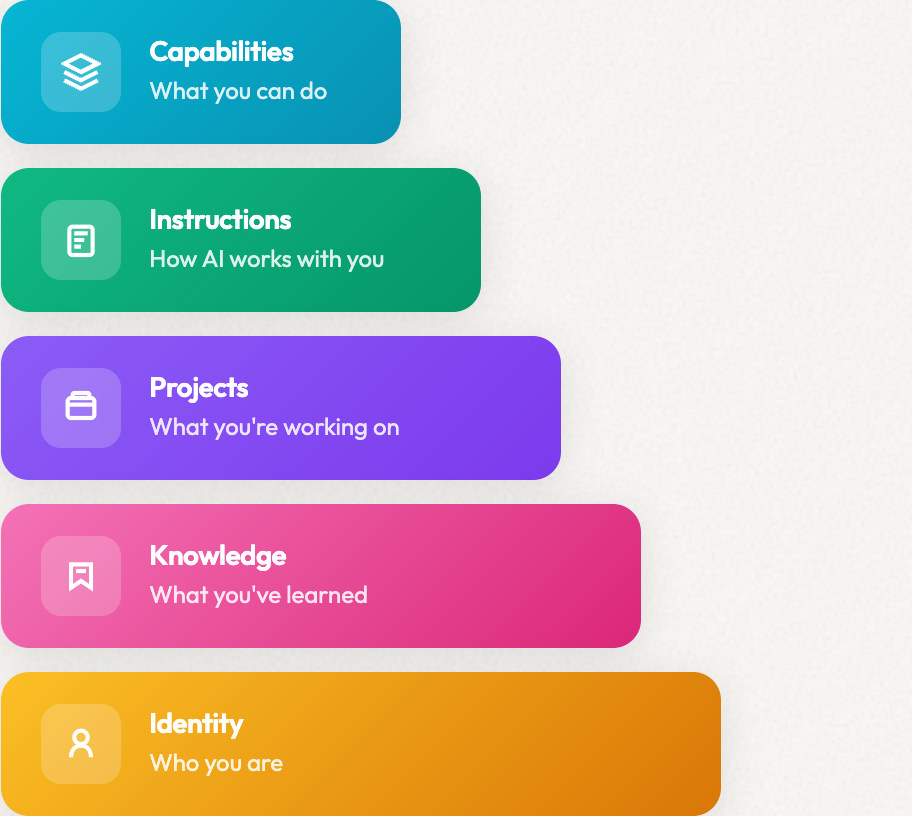
The real advantage isn't which chatbot you use. It's building a context layer that works across tools: Identity (your brand), Knowledge (what you've learned), Projects (what you're working on), Instructions (how AI collaborates), and Capabilities (agents that do the work).
ChatGPT vs Claude at a Glance
Here's the quick comparison most people want. But stay with me, because this table doesn't tell the whole story.
Pricing Comparison (January 2026)
| Plan | ChatGPT | Claude |
|---|---|---|
| Free | Limited GPT-5.2, basic features | Basic access on all platforms |
| Mid-tier | Go: $8/mo | - |
| Pro/Plus | Plus: $20/mo | Pro: $17-20/mo |
| Power user | Pro: $200/mo | Max: $100+/mo |
| Teams | $25/user/mo | $25-150/seat |
Sources: OpenAI Pricing, Anthropic Pricing
Winner: Roughly equivalent for most marketers. Claude Pro is slightly cheaper annually.
Key Features for Marketers
| Feature | ChatGPT | Claude |
|---|---|---|
| Context window | 128K-196K (Plus), 400K (API) | 200K standard, 500K-1M (Enterprise) |
| Image generation | Yes (DALL-E) | No |
| Video generation | Yes (Sora) | No |
| Web search | Yes | Yes |
| Projects/workspaces | Custom GPTs | Projects |
| Memory | Yes | Yes |
| Real-time editing | Canvas | Artifacts |
| Coding capability | Codex | Claude Code |
Winner: ChatGPT for multimedia. Claude for enterprise context and coding.
The Comparison Everyone Else Is Making (Chat vs Chat)
Let's do the standard comparison first. If you're just using the chat interfaces, here's how they stack up for common marketing tasks:
Blog Post Drafts
Claude wins. The writing is more natural, maintains better coherence across long pieces, and needs less editing. ChatGPT tends toward a recognizable "AI voice" that's harder to remove.
Social Media Captions
ChatGPT wins. It's faster at generating variations, more punchy with short-form copy, and the SEO-awareness is stronger.
Email Subject Lines
ChatGPT wins. Better at generating high-volume options quickly. More willing to be bold.
Long-Form Guides
Claude wins. While ChatGPT has largely caught up on context window size (196K for GPT-5 Thinking vs Claude's 200K), Claude still maintains better coherence across 3,000+ word pieces. The difference isn't the raw token count anymore. It's how the models handle that context.
Brand Voice Matching
Claude wins. Claude Projects let you upload your entire brand guidelines and keep them persistent. ChatGPT's custom instructions are more limited. (See my guide on how to make AI write in your brand voice for setup instructions.)
SEO Content
ChatGPT has an edge. It auto-suggests meta descriptions, has stronger keyword awareness, and integrates schema markup more naturally.
Brainstorming
ChatGPT wins. More creative variations, more willing to throw out wild ideas, better at quantity over quality.
Strategy Documents
Claude wins. The reasoning is deeper, the structure is cleaner, and it handles complex strategic thinking better.
Ad Copy
Tie. Both are capable with the right prompts. ChatGPT is slightly more punchy; Claude adds more personality.
Research Synthesis
Claude wins. Both tools now have similar context windows for most users, but Claude handles document synthesis more coherently. For enterprise users, Claude's 500K-1M context options give it a clear edge for large-scale research.
The Comparison You Should Be Making (Claude Code Changes Everything)
Here's where I lose most readers. But this is the actual insight.
Claude Code is not Claude the chatbot. It's a command-line tool that runs on your computer, reads your files, and builds things.
And if the command line sounds intimidating, Anthropic just launched Claude Cowork (January 2026) - which is essentially "Claude Code for non-developers." You point Claude at a folder on your computer, describe what you want, and it reads files, creates documents, extracts data, and organizes your work. No terminal required.
Cowork is the accessible entry point. You can use it to turn a folder of receipt photos into an expense spreadsheet, or compile research notes into a draft blog post. It's available to Pro subscribers ($20/month) and runs right in the Claude desktop app.
But Claude Code is where the real power is. If you're willing to learn the command line, you get capabilities that feel like science fiction.
For marketers, this means:
Building AI Employees
I don't just "chat with Claude" anymore. I have AI employees that handle specific marketing functions.
At the B2B SaaS company where I lead marketing, I've built:
- A content repurposing system that takes one blog post and creates LinkedIn posts, email copy, and Twitter threads
- A competitive intelligence monitor that tracks competitor pricing and messaging changes
- A customer interview analyzer that pulls patterns from sales call transcripts
These aren't prompts. They're systems. And Claude Code is what made them possible for someone without a software engineering background.
The "Vibe Coding" Revolution
There's a movement happening that most marketers haven't noticed yet. It's called "vibe coding." The idea is that you can describe what you want in natural language and AI builds it.
Claude Code is the best tool for this I've found. Not because the model is smarter than GPT-5.2. But because it's designed to work with your actual files and codebase.
I'm not a developer. But with Claude Code and Cursor, I've built marketing tools that would have taken weeks to spec out and thousands of dollars to have developed.
What This Means for You
If you're comparing ChatGPT chat vs Claude chat, you're comparing bicycles. Claude Code is a motorcycle.
The catch: there's a learning curve. You need to be comfortable with the command line. You need to think in systems, not prompts.
But if you're the kind of marketer who wants to build once and run forever, this is where the real advantage is.
Building a Portable System (The Real Strategy)
Here's what I wish someone had told me two years ago:
Stop optimizing for which AI is best today. Start building systems that work across tools.
The AI landscape changes every few months. GPT-4 was dominant, then Claude 3 came out. Claude 3.5 Sonnet was the best coding model, then GPT-5 arrived. Now we're on Claude Opus 4.5 and GPT-5.2.
If you're constantly relearning how to prompt the latest model, you're on a treadmill.
The Context Layer Approach
What doesn't change: your brand voice. Your positioning. Your audience insights. Your content frameworks.
I call this the "context layer." It's the persistent infrastructure that makes any AI actually useful for your specific marketing work. (I wrote more about this in What is a Context Layer for AI?)
Here's how I structure it:
- Brand identity documents that work across any AI tool
- Persona files with psychographic detail, not just demographics
- Content frameworks that define structure, not just topics
- Voice examples showing what good looks like
When I moved from ChatGPT to Claude, I didn't start over. I ported my context layer. The prompts changed; the foundation didn't.
Tool-Agnostic Workflow
My actual workflow today uses multiple tools:
- Claude Code for building marketing systems and AI employees
- Claude chat for long-form writing and strategic thinking
- ChatGPT for brainstorming, social content, and visual assets
- Perplexity for research with citations
This isn't hedging. It's using each tool for what it's best at.
My Actual Workflow Today
Let me show you exactly what this looks like in practice. Fair warning: my workflow has shifted heavily toward Claude. I'm not saying ChatGPT is bad - I'm saying once you start building systems instead of just chatting, the tool choice changes.
Weekly Blog Post
- Research in Perplexity - Get current data with citations
- Write in Claude Code - It has my entire context layer loaded, knows my voice, and can read/write files directly
- Final edit manually - Human polish
Building Marketing Systems
This is where I spend most of my time now:
- Design in Claude Code - What should this system do?
- Build in Claude Code or Cursor - Create the actual tool
- Iterate in Claude Code - Debug and improve
- Document in Claude Code - It writes the instructions into my knowledge base
Quick Tasks
For quick writing or thinking through a problem, I use Claude chat (claude.ai). The Projects feature keeps my brand context loaded.
When ChatGPT Still Makes Sense
To be fair, here's where ChatGPT has advantages I don't use but you might:
- Image generation - Claude can't do this natively. If you need DALL-E or Sora, ChatGPT is the obvious choice.
- High-volume brainstorming - ChatGPT generates more variations faster
- The ecosystem - Custom GPTs, plugins, and integrations are more mature
I've just found that once you're building systems instead of chatting, Claude's tooling (Claude Code, Cowork, Projects) fits better.
Questions You Might Have
Is ChatGPT or Claude better for marketing?
It depends on the task. ChatGPT is better for speed, variety, and visual content. Claude is better for depth, voice consistency, and building systems. Most serious marketers benefit from using both.
Can ChatGPT or Claude replace my marketing team?
No. But either can multiply your output significantly. With the right context layer, a solo marketer can produce what used to require 2-3 people. The AI handles first drafts and variations; you handle strategy and final polish.
Why does Claude sound more human than ChatGPT?
This is partly training philosophy. Anthropic's "Constitutional AI" approach emphasizes natural language. But it's also about how you use it. Claude's Projects feature allows better persistent context, which produces more personalized output. The raw specs have converged (both support 128K-200K context now), but Claude's handling of that context still feels more natural for long-form work.
Should I pay for ChatGPT Plus or Claude Pro?
If you use AI daily for marketing work, both are worth it. Start with one based on your primary use case. If you mostly do long-form content, start with Claude. If you need images and fast brainstorming, start with ChatGPT. You'll probably end up with both eventually.
Can I use ChatGPT and Claude together?
Yes, and that's often the best approach. Use each tool for what it's best at. The key is building a portable context layer that works across both, so you're not retraining each tool from scratch.
What is Claude Code and why should marketers care?
Claude Code is Anthropic's command-line tool that can read your files, write code, and build things. For marketers, it enables building custom AI systems and automation without being a developer. It's the difference between chatting with AI and having AI work for you.
What's the difference between Claude Code and Claude Cowork?
Claude Code requires the command line and is more powerful - you can build entire marketing systems with it. Claude Cowork (launched January 2026) is the accessible version: you point it at a folder, describe what you want, and it works on your files. Cowork is perfect for tasks like organizing research, extracting data from documents, or drafting reports. Start with Cowork if you're new to agentic AI; graduate to Claude Code when you're ready for more control.
Final Verdict
If you're just comparing chat interfaces, here's the simple answer:
- ChatGPT for speed, visuals, and brainstorming
- Claude for depth, voice, and long-form
But that comparison misses the bigger picture.
The marketers getting the most value from AI aren't debating which chatbot is better. They're building systems. Claude Code is the tool that makes this possible for non-developers.
And regardless of which tool you use, the real differentiator is your context layer. The brand voice, audience insights, and frameworks that make AI actually useful for your specific work.
Build that foundation, and you'll be ready for whatever model is "best" next month.
What's been your experience with ChatGPT vs Claude? I'm curious what's worked for your marketing workflow.
Stop Comparing. Start Building.
The context layer that works everywhere
ChatGPT vs Claude debates will be outdated in 6 months. Your context layer won't. Learn how to build portable marketing infrastructure that makes any AI tool work for you, regardless of which model is "best" today.
Building context that compounds.